'/%3e%3cpath%20d='m3.96875-28.015625h12.03125c1.738281%200%203.28125.25%204.625.75%201.351562.492187%202.46875%201.179687%203.34375%202.0625.695312.6875%201.226562%201.5%201.59375%202.4375.375.929687.5625%201.953125.5625%203.078125v.078125c0%201.179687-.1875%202.230469-.5625%203.15625-.367188.917969-.890625%201.714844-1.578125%202.390625-.679687.679688-1.484375%201.242188-2.421875%201.6875-.929688.4375-1.9375.75-3.03125.9375l8.59375%2011.4375h-3.875l-8.125-10.890625h-8v10.890625h-3.15625zm11.75%2014.296875c1.039062%200%202-.132812%202.875-.40625.882812-.269531%201.644531-.648438%202.28125-1.140625.644531-.488281%201.144531-1.085937%201.5-1.796875.363281-.707031.546875-1.515625.546875-2.421875v-.078125c0-1.738281-.625-3.09375-1.875-4.0625-1.25-.976562-3.011719-1.46875-5.28125-1.46875h-8.640625v11.375zm0%200'%20fill='%23000'%20transform='translate(133.876559%20199.437321)'/%3e%3cpath%20d='m14.328125-28.21875h2.953125l12.765625%2028.21875h-3.390625l-3.28125-7.40625h-15.25l-3.328125%207.40625h-3.234375zm7.796875%2017.96875-6.359375-14.28125-6.40625%2014.28125zm0%200'%20fill='%23000'%20transform='translate(170.934937%20199.437321)'/%3e%3cpath%20d='m4.234375-28.015625h3.171875v28.015625h-3.171875zm0%200'%20fill='%23000'%20transform='translate(210.674618%20199.437321)'/%3e%3cpath%20d='m1.5625-28.015625h3.515625l9.96875%2024.140625%2010-24.140625h3.40625l-12.046875%2028.21875h-2.796875zm0%200'%20fill='%23000'%20transform='translate(230.444594%20199.437321)'/%3e%3cpath%20d='m3.96875-28.015625h20.234375v2.890625h-17.078125v9.5625h15.28125v2.875h-15.28125v9.8125h17.28125v2.875h-20.4375zm0%200'%20fill='%23000'%20transform='translate(268.583504%20199.437321)'/%3e%3cg%20fill='none'%20stroke='%23000'%20stroke-width='2'%3e%3cpath%20d='m.00089378.998939h147.99480122'%20transform='matrix(.75%200%200%20.75%2069.815736%20154.37189)'/%3e%3cpath%20d='m.00089378.999531h147.99480122'%20transform='matrix(.75%200%200%20.75%2069.815736%20215.461289)'/%3e%3cpath%20d='m.00230561.99905h82.37500539'%20transform='matrix(0%20-.75%20.75%200%2069.758525%20216.904073)'/%3e%3c/g%3e%3c/svg%3e)
The Frankenstack: What Disconnected Software Is Costing You In Revenue
A new patient fills out a contact form on a practice's website at 4:30 on a Friday afternoon.
The form lives in their marketing platform. Their scheduling software is a different platform. So the lead sits there over the weekend until someone logs in Monday, copies it over, and starts the follow-up Tuesday.
By Tuesday the patient has already booked somewhere else. They booked Friday night, from their couch, with whoever answered first.
Nobody on that team did anything wrong. The lead just sat in the wrong system for 96 hours because the only thing that moves it from one platform to the next is a human being who went home for the weekend.
That practice will never see this on a report. There's no line item called "patient we lost because our software doesn't talk to itself." The hours their team spends patching the gap show up eventually. The revenue walking out the door never does.
I see some version of this in almost every business I sit down with. In fact, the example above is from a client of Braive. And there's a name for it.
What Is a Frankenstack?
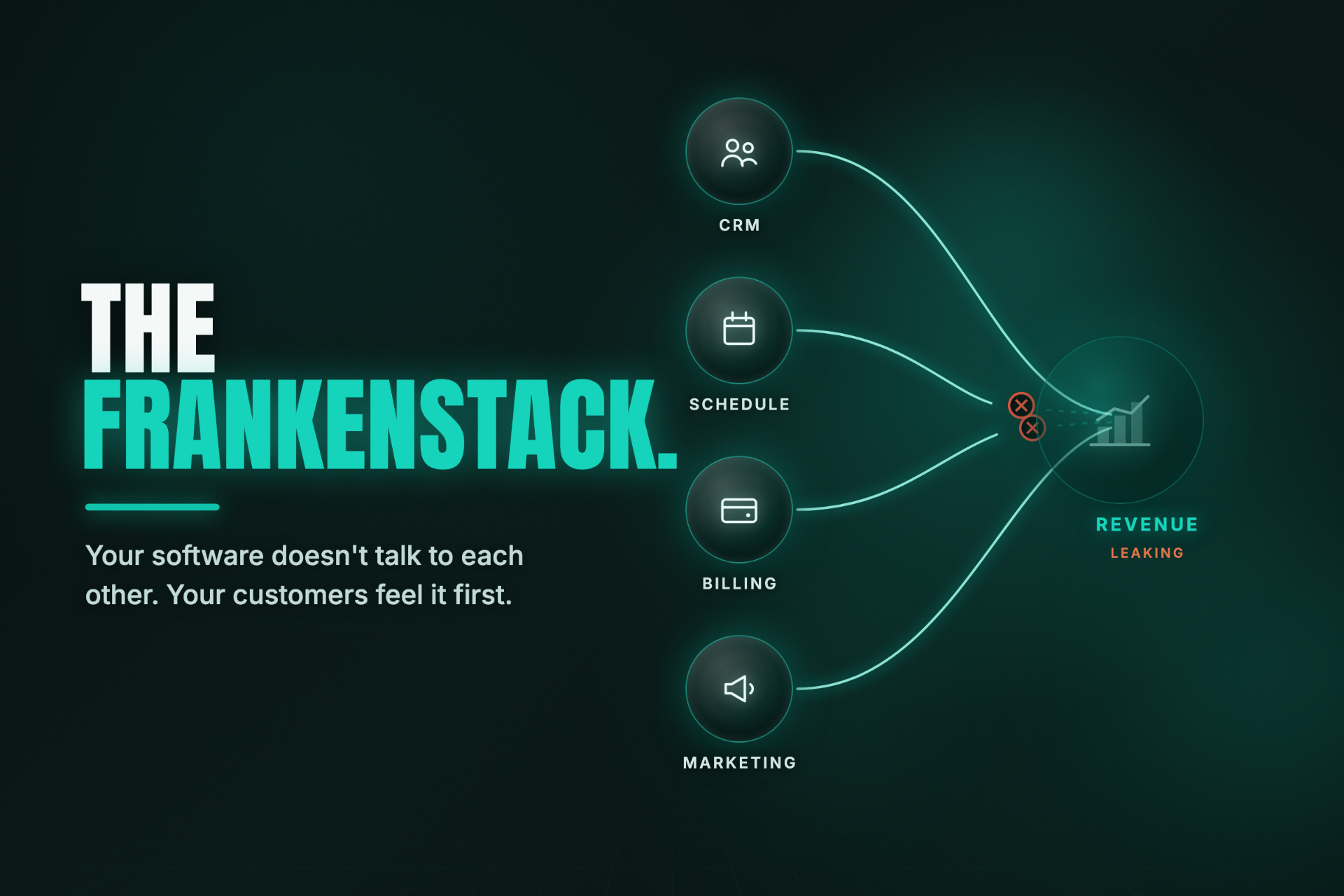
A Frankenstack is what you get when you buy software one problem at a time and never connect the pieces.
A CRM because you needed to track contacts. A scheduler because you were double-booking. A texting platform because nobody answers the phone anymore. A billing tool, a project board, a support inbox, a marketing automation app. Every one of them earned its place. Every one of them solved the problem in front of you the day you bought it.
What none of them do is talk to each other.
So you end up with eight or twelve platforms that each work fine on their own and add up to a business that runs on copy-paste. A lead moves from marketing to sales because a person moves it. A customer's status changes in one system and stays wrong in three others until someone updates them by hand. Something happens in platform A that should trigger platform B, and the thing that connects A to B is your office manager's memory.
That person is your operating layer. They're the reason it holds together. They're also the reason it breaks the first week they're out sick.
Your Customers Feel It First
Here's the part most owners miss. They think of this as an internal headache. Wasted time, annoyed staff, a few too many spreadsheets. Survivable.
The expensive damage is happening on the other side of the desk, where your customers live.
Slow beats good, and a Frankenstack makes you slow. A lead comes in at 4:30 PM and gets a real response 64 hours later because that's how long it took to surface in the right system. The competitor whose tools are wired together replied at 4:31. You were second. In a purchase that moves that fast, second is just a slower way to lose.
Your customer can tell the left hand doesn't know what the right is doing. They call about their account. Your rep pulls it up, but billing lives somewhere else, so the rep is half-blind and the customer is repeating things they already told you. It's a small moment. It's also the exact moment a customer starts wondering whether you've got your act together. You won't find that in any report either. You'll find it later, in your churn number.
Deals die in the gap between two tools and nobody notices. A rep logs a follow-up in the CRM. The follow-up sequence lives in a different app and needs the rep to kick it off by hand. The rep has eleven other accounts on fire that day. The follow-up never goes. The deal goes silent. It doesn't get marked lost. It just stops showing up in the forecast, and you never know it was there to win.
This is where the Frankenstack actually bleeds you. You spend all your worry on the wasted hours, because you can see those. The customers slipping through the seams cost you more, and you never get a chance to count them.
The Math Nobody Runs
Pick one workflow that crosses more than two platforms. Count the hours a week your team spends just moving information between them. Not deciding anything. Not using a lick of expertise. Just carrying data from one box to another.
Say it's five hours. That's 260 hours a year. At $35 an hour, you're paying $9,100 for work that creates nothing.
Most businesses have three to five of these running at once, so the real number lands somewhere between $25,000 and $40,000 a year. And that's only the part you can put on a spreadsheet, before you count a single lost customer.
The lost-customer number is bigger. It's always bigger. Much much bigger! It's just harder to look at, so most owners don't.
Why This Happens to Good Operators
Nobody sets out to build a Frankenstack. You build it one reasonable decision at a time.
You add the scheduler the month appointments start slipping. You bolt on a payment tool when the CRM's billing falls short. You buy the marketing platform the quarter sales needs more leads. Each call was the right call. Nobody's job was ever to step back and ask how all eleven of these things were supposed to work as one.
Three years later you're running a dozen tools held together by one person's habits, and half the people who set them up don't even work here anymore.
The instinct at that point is to buy your way out. Another app. A connector. A shiny platform that promises to tie it all together. Read AI Isn't a Magic Wand. It's Leverage. before you do, because adding a thirteenth tool to a twelve-tool problem gives you thirteen islands. The tools were never the problem. The way they're wired together is.
What Fixing It Looks Like
We sat down with our orthodontics client running five platforms: patient communication, treatment financing, clinical records, supplies, and marketing.
Every Friday, their coordinator spent five hours moving data between those five systems by hand. They ran it off a laminated paper checklist taped to the desk. Five hours, every week, doing work that only existed because none of the software shared a thing.
The Fridays were the visible cost. The real cost was quieter. After-hours inquiries sat untouched till Monday. A financing approval didn't kick off the next patient message on its own. A patient who needed a follow-up appointment got remembered, or didn't, depending on whether someone opened the right file.
We're not replacing their software. Yet. We're building a layer over the top of it that handles the handoffs the way that office manager used to.
A new inquiry comes in, the layer routes it and fires the first message no matter the hour. Financing clears, the next patient communication queues itself. A gap opens in someone's care timeline, the layer flags it before anyone has to go looking.
We mapped 14 handoff points across their five tools. Eleven of them were dumb, repeatable transfers a rule could do in its sleep. Three needed an actual human with actual judgment, the clinical and relationship calls a rule has no business making.
Those three are where their team spends its time now. Response to a new inquiry goes from 64 hours to under 30 minutes. The laminated checklist is in a drawer somewhere. Friday afternoons belong to them again.
Where to Start This Week
You don't need us to find your Frankenstack. You need an hour and one workflow.
Pick something that touches a customer. How a new lead comes in. How a client gets onboarded. How a renewal or reorder fires. Walk it step by step and mark every spot where a person has to carry data from one tool to the next with no decision attached.
That list is your revenue leak, written in your own handwriting.
If you'd rather start with a faster read on where you're exposed, take the Score Your Pipeline quiz. Three minutes of questions, and it tells you which parts of your process are leaking before you've mapped a single workflow.
Your pipeline can look fine on paper and still be losing money in the gaps between your tools. Go find one gap. Start there.
See where your pipeline is leaking.
Related Reading
- You Have 12 Months to Integrate AI into Your Marketing Operations. Why the window to wire this up is shorter than you think.
- AI Isn't a Magic Wand. It's Leverage.. Why the fix is a new operating model instead of a new app.
Frequently Asked Questions
What is a Frankenstack?
A Frankenstack is a business technology stack built from multiple software platforms that don't share data automatically. Each tool works on its own, but moving information between them takes a human. Those manual handoffs are where delays, errors, and lost revenue pile up.
How does a Frankenstack hurt revenue?
It costs you customers in the gaps between your tools. Leads get slow responses because they sit in the wrong system. Follow-ups never fire because the handoff needed a person who was busy. Customers get a disjointed experience and quietly leave. The revenue lost this way is usually bigger than the labor cost, and a lot harder to see.
What is a central operating layer?
It's a system built on top of your existing software that automates the handoffs between platforms. When something changes in one tool, the operating layer moves it, triggers the next step, and updates the other systems on its own. You keep your current tools. They finally start acting like one system instead of a dozen.
How do I know if my business has a Frankenstack problem?
Take one customer-facing workflow and map every step where a person moves data between two platforms with no real decision involved. More than two of those steps in a single workflow, and the Frankenstack is already costing you. The Score Your Pipeline quiz is a faster way to see where you're most exposed.
How much does a Frankenstack cost?
A team spending five hours a week on manual cross-system work burns about $9,100 a year in labor at average rates. Run three to five of those workflows at once, common for most service businesses, and you're at $25,000 to $40,000 a year. That's before a single dollar of revenue lost to slow responses, dropped follow-ups, and customers who churn.
Keep reading.
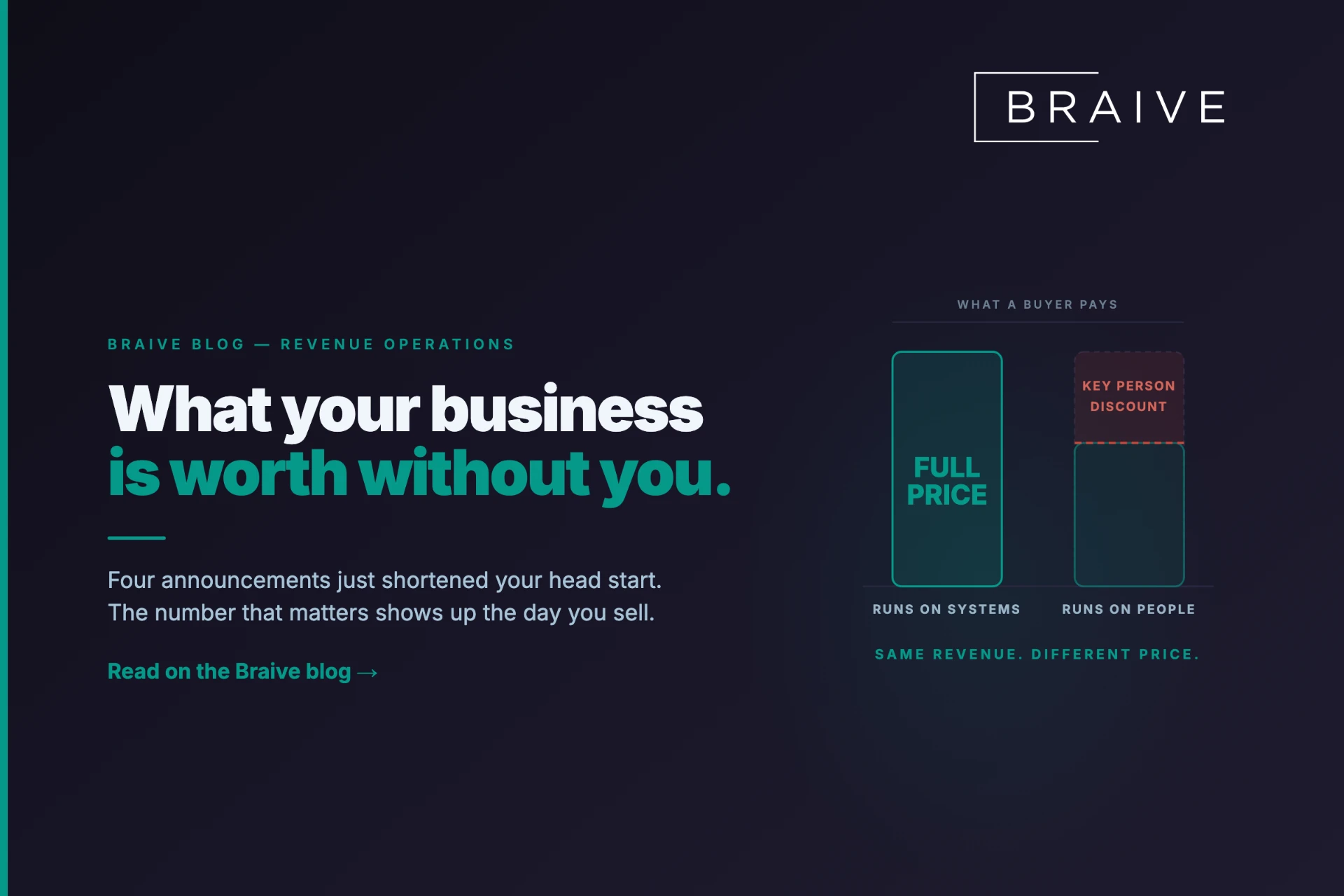
What Your Business Is Worth When You're Not in the Room
Four AI announcements just shortened your head start. What that window is worth shows up the day you sell, in an adjustment buyers call the key person discount.
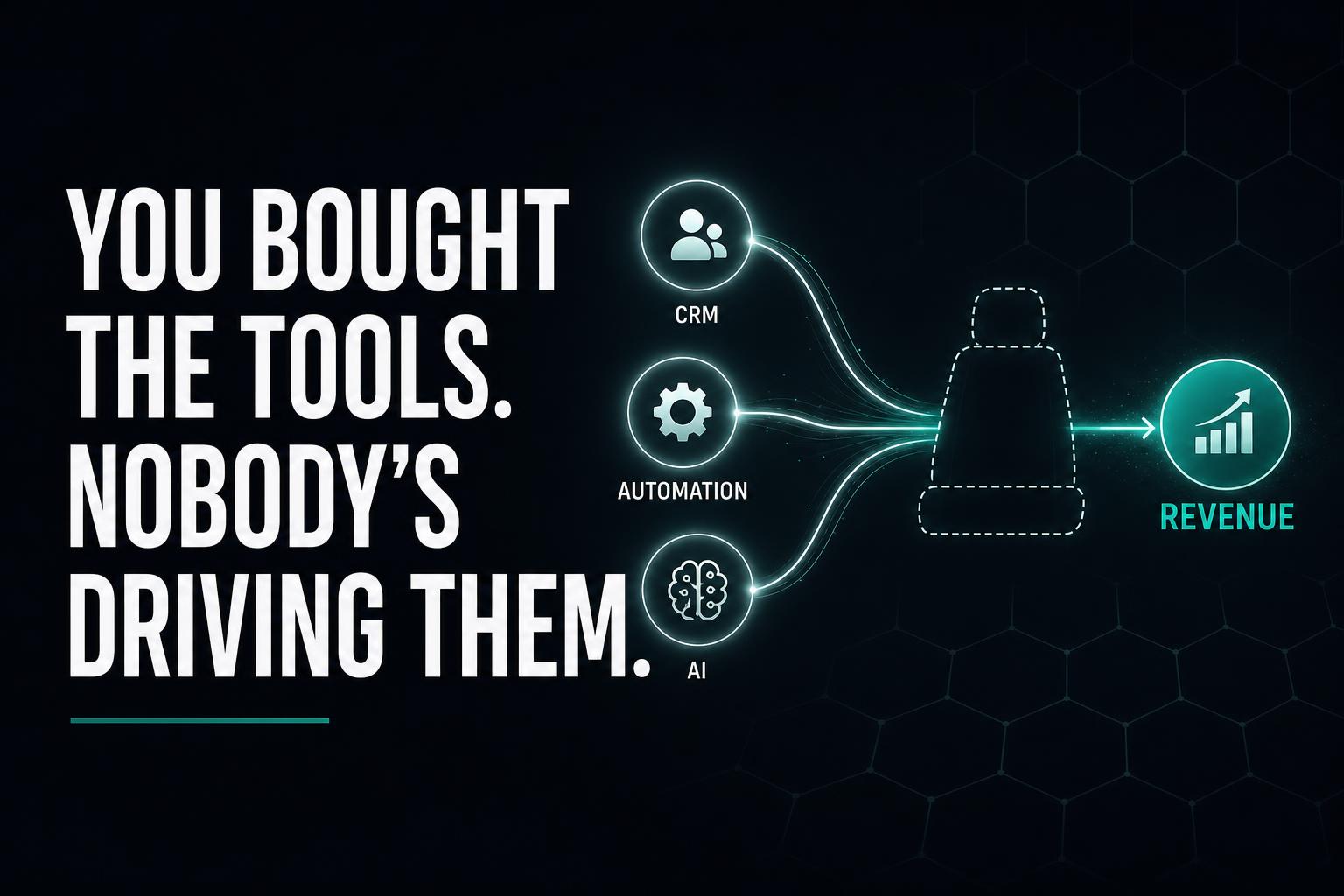
You Bought the Tools. Nobody's Driving Them.
Everyone has the tools. Almost no one has an owner. The revenue operations layer is where adoption turns into results — and it's the seat most small businesses leave empty.
See where your pipeline is exposed.
12 questions. 3 minutes. Find out exactly where your operation is losing revenue — and what to do about it.