'/%3e%3cpath%20d='m3.96875-28.015625h12.03125c1.738281%200%203.28125.25%204.625.75%201.351562.492187%202.46875%201.179687%203.34375%202.0625.695312.6875%201.226562%201.5%201.59375%202.4375.375.929687.5625%201.953125.5625%203.078125v.078125c0%201.179687-.1875%202.230469-.5625%203.15625-.367188.917969-.890625%201.714844-1.578125%202.390625-.679687.679688-1.484375%201.242188-2.421875%201.6875-.929688.4375-1.9375.75-3.03125.9375l8.59375%2011.4375h-3.875l-8.125-10.890625h-8v10.890625h-3.15625zm11.75%2014.296875c1.039062%200%202-.132812%202.875-.40625.882812-.269531%201.644531-.648438%202.28125-1.140625.644531-.488281%201.144531-1.085937%201.5-1.796875.363281-.707031.546875-1.515625.546875-2.421875v-.078125c0-1.738281-.625-3.09375-1.875-4.0625-1.25-.976562-3.011719-1.46875-5.28125-1.46875h-8.640625v11.375zm0%200'%20fill='%23000'%20transform='translate(133.876559%20199.437321)'/%3e%3cpath%20d='m14.328125-28.21875h2.953125l12.765625%2028.21875h-3.390625l-3.28125-7.40625h-15.25l-3.328125%207.40625h-3.234375zm7.796875%2017.96875-6.359375-14.28125-6.40625%2014.28125zm0%200'%20fill='%23000'%20transform='translate(170.934937%20199.437321)'/%3e%3cpath%20d='m4.234375-28.015625h3.171875v28.015625h-3.171875zm0%200'%20fill='%23000'%20transform='translate(210.674618%20199.437321)'/%3e%3cpath%20d='m1.5625-28.015625h3.515625l9.96875%2024.140625%2010-24.140625h3.40625l-12.046875%2028.21875h-2.796875zm0%200'%20fill='%23000'%20transform='translate(230.444594%20199.437321)'/%3e%3cpath%20d='m3.96875-28.015625h20.234375v2.890625h-17.078125v9.5625h15.28125v2.875h-15.28125v9.8125h17.28125v2.875h-20.4375zm0%200'%20fill='%23000'%20transform='translate(268.583504%20199.437321)'/%3e%3cg%20fill='none'%20stroke='%23000'%20stroke-width='2'%3e%3cpath%20d='m.00089378.998939h147.99480122'%20transform='matrix(.75%200%200%20.75%2069.815736%20154.37189)'/%3e%3cpath%20d='m.00089378.999531h147.99480122'%20transform='matrix(.75%200%200%20.75%2069.815736%20215.461289)'/%3e%3cpath%20d='m.00230561.99905h82.37500539'%20transform='matrix(0%20-.75%20.75%200%2069.758525%20216.904073)'/%3e%3c/g%3e%3c/svg%3e)
What Your Business Is Worth When You're Not in the Room
Over the last ten months, four announcements landed that almost nobody I talk to has read.
Last October, Deloitte trained and certified 15,000 of its consultants to install AI inside other companies. That December, Accenture did the same thing with around 30,000 people. In February, OpenAI signed McKinsey, Boston Consulting Group, Accenture, and Capgemini in a single announcement, each of them standing up a certified team whose entire job is connecting AI to a client's existing CRM, sales data, and back-office systems. Last week (August 26th), Salesforce announced it's building that same capability directly into its own software.
Four announcements, one obstacle, hit from both sides.
If you run a company doing five or thirty million a year, none of that was written for you. It was written for the enterprise, by the enterprise.
But you should still care, and not for the reason you'd expect.
What Those Announcements Were Actually Fixing
Big companies have been bad at this. In July 2025, a team at MIT published a report that got quoted everywhere: 95% of corporate AI pilots produced no measurable effect on the bottom line.
The reason those projects failed is the part worth reading.
Most of those companies never got the technology deep enough into the actual work to matter. They ran it next to the business instead of inside it, because inside meant touching the ERP, the CRM, the twenty-year-old system finance won't let anyone near, and every compliance review sitting between a good idea and a live release. So they built something impressive off to the side, put it in a press release, and nothing moved.
There's a second reason I don't see discussed much. Whoever did the work usually never got deep enough into the business to know where it belonged, or what would happen when it broke. At that scale, when something breaks, it breaks loudly. Nobody gets three months to tune it while shareholders are asking why it's still running.
And then there's the part that has nothing to do with technology at all. Every one of those projects needed a few hundred people to stop doing their job the way they'd done it for ten years. Installing the thing is the easy half. Getting people to actually use it is a separate project, and it's the one that kills most of them. That work is slow, it's political, and it can only be done by humans sitting with other humans.
Which is exactly why the fix came in the shape it did. Big companies don't do this work themselves. They hire firms to do it, and the supply of people who could actually do it was small. That was the bottleneck, and those four announcements are the industry hiring its way through it. Fifteen thousand certified consultants at one firm alone, each of them billing out to walk into a large company, wire this into whatever it already runs, and stay long enough to make the staff use it.
What That Difficulty Was Doing For You
All of that friction is the reason big companies were slow. It is also the reason you could out-move them.
A company doing $12 million with four systems and a decision-maker who answers his own email can wire a working AI process into the actual business in a few weeks. Take that same idea into a $4 billion enterprise and you get eighteen months, four vendors, a steering committee, a security review, and two of the people who kicked it off leaving the company before it ships.
A Fortune 500 CIO has forgotten more about technology than most of us will ever learn, and has a budget line for it that would cover your payroll. You could still just...go, while they couldn't.
That gap is real, and you've been living inside it for two years whether you noticed or not.
None of this recent news made your business worse. It just shortened your ability to capitalize on the head start that was gifted to you.
You Were Never Trying to Beat Them Anyway
If you run a five or thirty million dollar company, you were probably never trying to become a four billion dollar one. That was never the plan. The plan, whether you've said it out loud or not, is that one day you sell this thing, or merge it, or hand it to your kids, or sell it to the people who helped you build it.
So the real question isn't who wins some AI race you never entered. It's what you build while the window is still open.
Because that is what the person buying your business is going to pay for.
The Term Buyers Use That Most Owners Never Hear
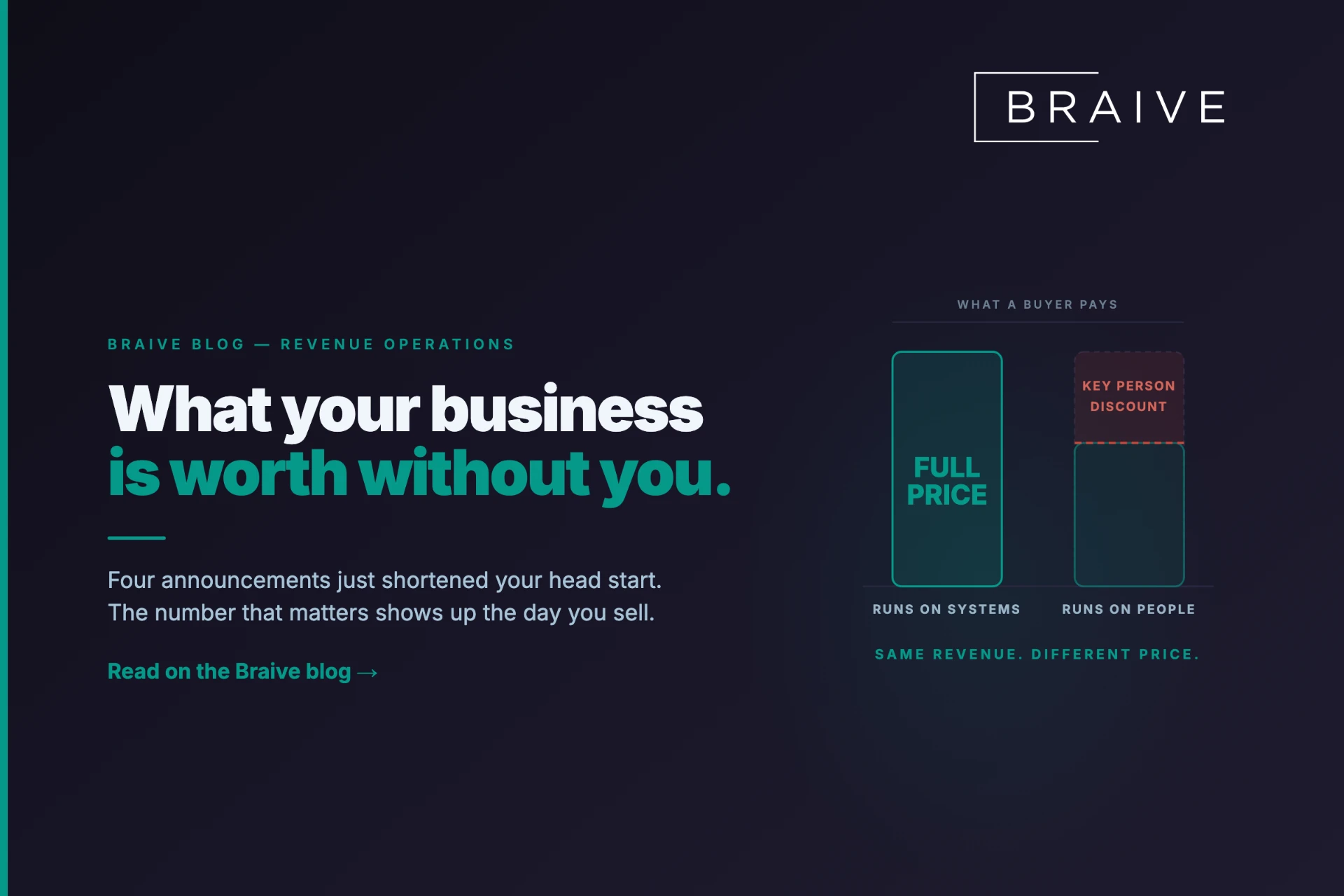
A buyer's job is to find reasons to pay you less. Every reason they find comes off your price. The financials are the easy part, and a decent diligence team gets through those in a week. What takes longer, and what moves the number more than most owners expect, is working out how much of this company is actually a company, and how much of it is you plus three people who know where everything is.
M&A advisors have a name for what happens when the answer comes back wrong. They call it the key person discount. It's a standard adjustment appraisers make when a business can't function without the person running it, and it takes a real bite out of the sale price.
A friend of mine who buys companies for a living said this: "there's one operations person who has all these processes in their head, and the buyer fires that person the day the deal closes, and it all walks out the door with them."
Sit on the other side of that table for a second. He isn't describing a villain. The buyer already has an operations team, and cutting the overlap between the two companies is usually part of how the deal got justified to their own investors in the first place. That headcount was spent before the papers were signed.
They could keep the person. Sometimes they do, and it costs them a retention bonus to hold onto knowledge that should have been sitting in the business already. Either way you get charged for it. If they cut, the knowledge walks. If they keep, they pay for it twice and price that into what they hand you.
Every process that only exists in somebody's head is a discount on your own price. Every process that runs on its own is the opposite.
That's the real argument for building this into your operation now, while you can still move faster than the companies above you. A business where quotes go out on time without anyone chasing them, where no lead goes uncalled because something is watching, where the reporting exists whether or not your ops manager is having a good week, is worth more than the same business doing the same revenue on memory and hustle.
It also grows faster while you still own it. You get both.
A business that runs without you is worth more today, whether you sell it, pass it down, or just want fewer calls on a Saturday. A sale is only the moment a stranger with a checkbook finally puts a number on it.
Put a Number on One Hole
Most of this stays abstract until you do the arithmetic, so let's do it. You don't need me for this part. You need ninety seconds and your own numbers.
What is one customer worth to you over a year?
How many real opportunities slip in a month?
Not the ones you lost fair and square to a better price. The ones that leaked. A form that came in at six on a Friday and got answered Monday. Two calls nobody picked up during a busy stretch. Three quotes that went out and were never chased.
Multiply those two numbers. Then multiply by twelve.
Say a customer is worth $8,000 to you in a year, and six real opportunities slip in an average month.
From one hole. Not the whole operation, not the industry-wide benchmark. One leak, in your business, using your numbers.
Most owners who run this land somewhere they didn't expect. The figure is rarely a rounding error, and it's rarely the problem they assumed was costing them the most.
If you can't fill in the middle number with any confidence, that's worth knowing too. It means the number is invisible to you right now, and invisible is where it stays until somebody goes and counts it.
That's the part I'd push back on hardest. Most owners don't know anything is wrong, because the problems I get hired to fix never show up on a report. Nobody runs a monthly statement for the leads that were never called back.
The Two Reasons Owners Wait
When I bring this up, I hear two objections more than any others.
The first: "I wouldn't know where to start, and I don't have time to go looking." Fair. The business has fifteen years of process built into it, most of it in people's heads, and no obvious place to put the wedge in. So it goes on the someday list and stays there.
The second sounds more reasonable and costs a lot more. "I'll wait until somebody builds the right thing for my industry."
Both end in the same place. Nothing happens, and the meter keeps running. The difference is that the first one knows it's stuck. The second one feels like a decision, which is why it can go on for years.
So it's worth saying plainly: there is no out-of-the-box version of your company.
The software you buy off the shelf handles the parts of your business that look like everyone else's. Invoicing. Email. Scheduling. Those are solved, and you already bought them.
Your money is in the other part. How a quote actually gets built and who decides the number. Which customer gets called back first when three are waiting. What happens to a job that goes sideways at four on a Friday.
That process is yours. Whether you run a lending shop, an insurance agency, a clinic, or a distribution business, the parts worth fixing are the parts nobody else has. No vendor can package those. Getting real value out of this means somebody sits down with your actual process and builds around it.
So "wait for the out-of-the-box version" is really "wait forever, while the guy across town stops waiting and starts taking your customers."
That's the part that stings later. Not that you fell behind on technology. That somebody in your market who is no smarter than you decided to go first, and by the time you noticed, they were answering leads in two minutes and you were answering them the next morning.
Start With the Diagnosis, Not the Build
"We need to do something with AI" is the wrong move, and it's the one I hear most.
You can only fix what you know is broken. Speed doesn't help if you're pointed at the wrong thing. A fast company that automates the wrong job just gets to the same revenue faster.
So the first step isn't building anything. It's finding out where the money is leaking, what each leak costs you over a year, and which one to fix first. That takes days, not quarters, which is the advantage of being your size.
If you want a quick read on where you're exposed, take the Score Your Pipeline quiz. Twelve questions, about three minutes. It scores four parts of your revenue process: how fast you respond to new inquiries, how far you actually chase a lead, what happens to the ones that go quiet, and what happens after the sale closes.
Then do one more thing with the result. Take whichever hole scored worst, go back up to the arithmetic, and put a real number on that one. Your customer value, your slipped opportunities, times twelve. That number is the thing worth acting on, and it's usually the reason people stop putting this off.
Whether you're selling in three years or handing this to your kids in fifteen, it's the same work, and it's worth more the earlier you start.
Find the leak. Put a number on it.
Related Reading
- You Have 12 Months to Integrate AI into Your Marketing Operations. Written before any of the above happened. The timeline argument holds up better than I'd like.
- AI Isn't a Magic Wand. It's Leverage.. Why moving fast on the wrong thing is still moving fast in the wrong direction.
Frequently Asked Questions
What did Deloitte, Accenture, OpenAI, and Salesforce actually announce?
Four separate moves aimed at the same obstacle. In October 2025, Deloitte trained and certified 15,000 consultants to implement AI inside client companies and gave 470,000 employees access to the tools. In December 2025, Accenture announced a partnership training roughly 30,000 of its people. In February 2026, OpenAI announced Frontier Alliances with McKinsey, Boston Consulting Group, Accenture, and Capgemini, each building certified teams to connect its agent platform to client CRM, data, and ERP systems. In August 2026, Salesforce and Anthropic announced Claudeforce, which puts Anthropic's Claude model directly inside Salesforce. Taken together, they make it faster and cheaper for large enterprises to do the thing that has been slow and expensive for them.
Why do those announcements matter to a $10M company?
Because the difficulty of installing AI inside a large legacy business is what has let smaller companies move faster than bigger ones for the last two years. You can decide something and have it running in weeks. A $4 billion company takes eighteen months. That gap has been a real advantage, and these announcements are aimed squarely at closing it.
What is the key person discount?
It's a standard adjustment appraisers and buyers make when a business depends heavily on one person, usually the owner or a single rainmaker. If the company can't function normally after that person leaves, the buyer prices in the risk, and it comes off the sale price. It applies whether the buyer is a strategic acquirer, a private equity firm, or your own employees financing a purchase.
Does building systems into my operation actually increase what my business is worth?
It changes how a buyer reads the risk. Buyers price a business partly on how transferable it is. If your quoting, follow-up, reporting, and handoffs run on documented systems, the business keeps working after the sale. If those things live in the heads of a few long-tenured employees, the buyer prices in the chance those people leave. Revenue and profit set the starting point. How much of the company runs without you moves the number from there.
Should I wait for an AI tool built specifically for my industry?
No. Off-the-shelf software already covers the parts of your business that look like everyone else's. The parts that make you money are specific to how your company works, and no vendor can package those. Waiting costs you twice: you don't get the gains, and a competitor who stopped waiting starts taking share while you do.
How do I calculate what a revenue leak is costing me?
Take what one customer is worth to you over a year, multiply it by how many real opportunities slip in an average month, then multiply by twelve. Six slipped opportunities a month at $8,000 each is $576,000 a year from a single hole. If you can't estimate the monthly number with confidence, that itself is the finding: the loss is invisible, and it stays invisible until someone counts it.
Is the 95% AI failure statistic real?
The figure comes from "The GenAI Divide: State of AI in Business 2025," published by MIT's NANDA initiative in July 2025. It found that 95% of enterprise AI pilots produced no measurable impact on profit and loss. Treat it as directional rather than precise. MIT labeled the report preliminary findings, it was not peer-reviewed, and it rests on 52 interviews plus 153 survey responses gathered at industry conferences, which is a small and self-selected base. At least one analyst has publicly called for the data to be released or the report withdrawn. The durable part of the finding is the explanation: those projects failed because companies avoided the hard work of building AI into their actual workflows.
Where should a $10M company start?
Start with a diagnosis, not a build. Find where revenue leaks out of your current process, put a dollar figure on what each leak costs over a year, and rank them. Most owners can name the symptom, such as deals going quiet or quotes taking too long, without being able to name the point of failure. The Score Your Pipeline quiz is a three-minute version of that exercise, and a Revenue Operations Team can run the full one in a couple of weeks.
Keep reading.
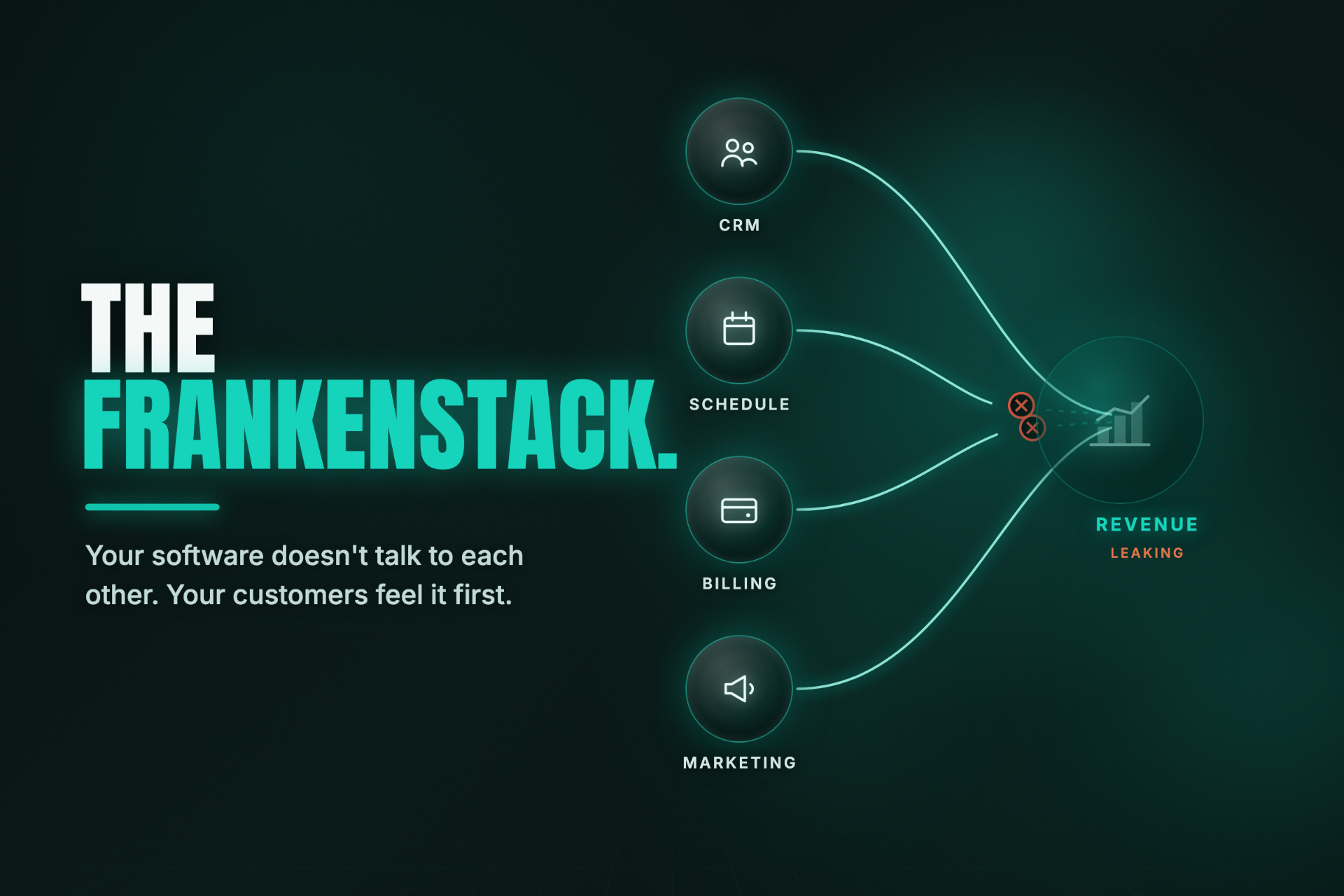
The Frankenstack: What Disconnected Software Is Costing You In Revenue
Your software doesn't talk to each other. See what the gaps between your tools cost you in lost customers and leaked revenue, and how to find them.
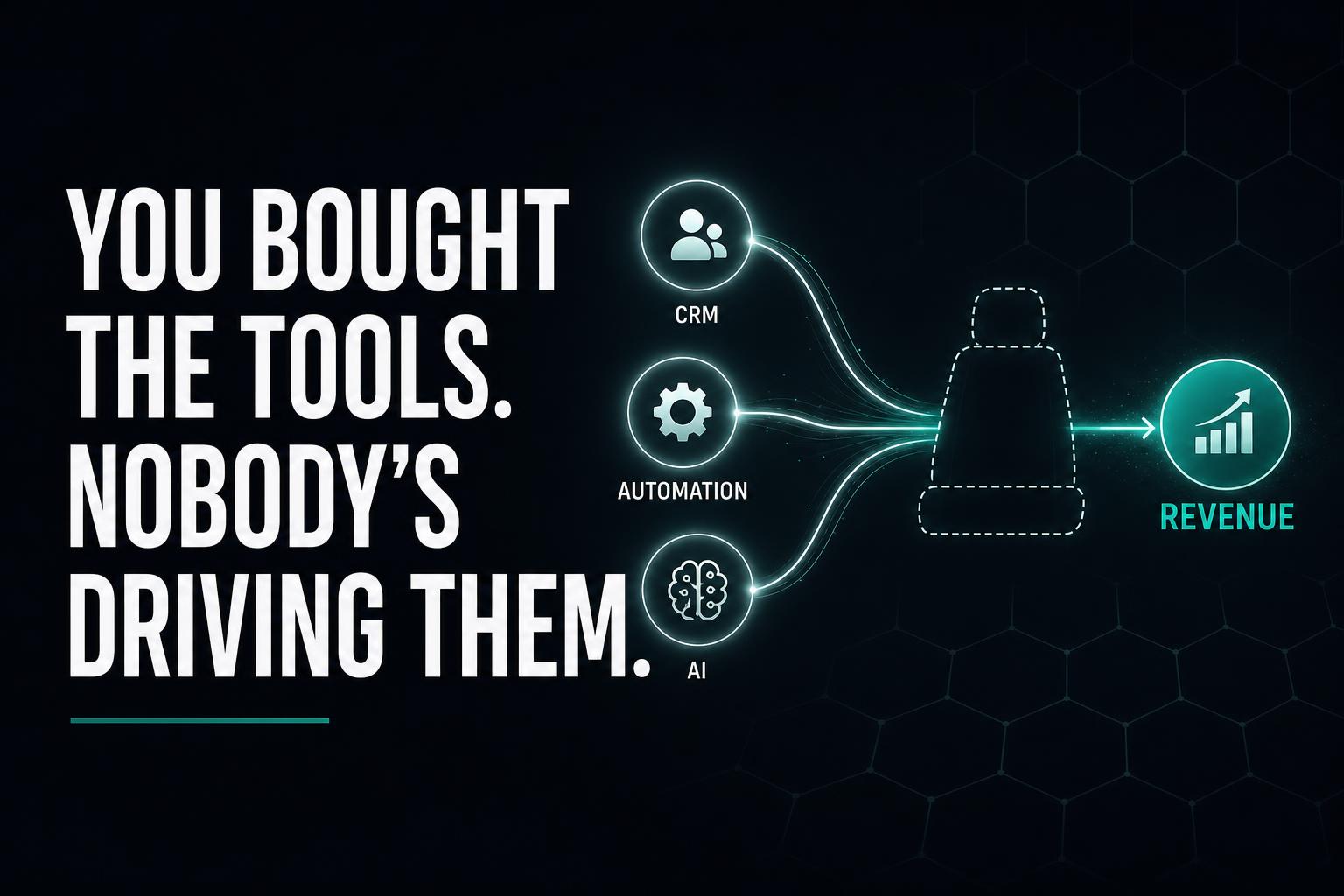
You Bought the Tools. Nobody's Driving Them.
Everyone has the tools. Almost no one has an owner. The revenue operations layer is where adoption turns into results — and it's the seat most small businesses leave empty.
See where your pipeline is exposed.
12 questions. 3 minutes. Find out exactly where your operation is losing revenue — and what to do about it.