'/%3e%3cpath%20d='m3.96875-28.015625h12.03125c1.738281%200%203.28125.25%204.625.75%201.351562.492187%202.46875%201.179687%203.34375%202.0625.695312.6875%201.226562%201.5%201.59375%202.4375.375.929687.5625%201.953125.5625%203.078125v.078125c0%201.179687-.1875%202.230469-.5625%203.15625-.367188.917969-.890625%201.714844-1.578125%202.390625-.679687.679688-1.484375%201.242188-2.421875%201.6875-.929688.4375-1.9375.75-3.03125.9375l8.59375%2011.4375h-3.875l-8.125-10.890625h-8v10.890625h-3.15625zm11.75%2014.296875c1.039062%200%202-.132812%202.875-.40625.882812-.269531%201.644531-.648438%202.28125-1.140625.644531-.488281%201.144531-1.085937%201.5-1.796875.363281-.707031.546875-1.515625.546875-2.421875v-.078125c0-1.738281-.625-3.09375-1.875-4.0625-1.25-.976562-3.011719-1.46875-5.28125-1.46875h-8.640625v11.375zm0%200'%20fill='%23000'%20transform='translate(133.876559%20199.437321)'/%3e%3cpath%20d='m14.328125-28.21875h2.953125l12.765625%2028.21875h-3.390625l-3.28125-7.40625h-15.25l-3.328125%207.40625h-3.234375zm7.796875%2017.96875-6.359375-14.28125-6.40625%2014.28125zm0%200'%20fill='%23000'%20transform='translate(170.934937%20199.437321)'/%3e%3cpath%20d='m4.234375-28.015625h3.171875v28.015625h-3.171875zm0%200'%20fill='%23000'%20transform='translate(210.674618%20199.437321)'/%3e%3cpath%20d='m1.5625-28.015625h3.515625l9.96875%2024.140625%2010-24.140625h3.40625l-12.046875%2028.21875h-2.796875zm0%200'%20fill='%23000'%20transform='translate(230.444594%20199.437321)'/%3e%3cpath%20d='m3.96875-28.015625h20.234375v2.890625h-17.078125v9.5625h15.28125v2.875h-15.28125v9.8125h17.28125v2.875h-20.4375zm0%200'%20fill='%23000'%20transform='translate(268.583504%20199.437321)'/%3e%3cg%20fill='none'%20stroke='%23000'%20stroke-width='2'%3e%3cpath%20d='m.00089378.998939h147.99480122'%20transform='matrix(.75%200%200%20.75%2069.815736%20154.37189)'/%3e%3cpath%20d='m.00089378.999531h147.99480122'%20transform='matrix(.75%200%200%20.75%2069.815736%20215.461289)'/%3e%3cpath%20d='m.00230561.99905h82.37500539'%20transform='matrix(0%20-.75%20.75%200%2069.758525%20216.904073)'/%3e%3c/g%3e%3c/svg%3e)
You Bought the Tools. Nobody's Driving Them.
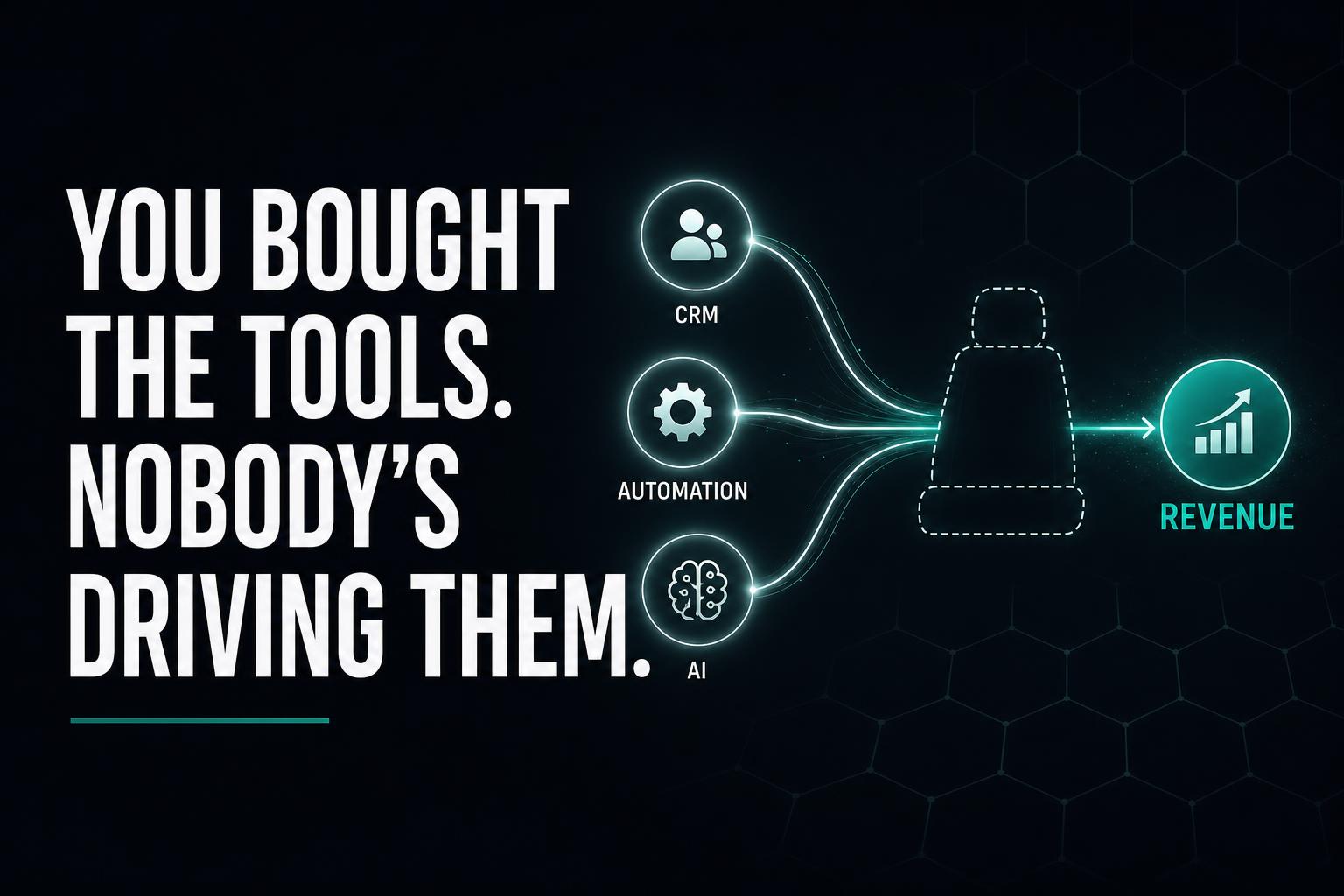
Everyone has the tools. Almost no one has an owner.
Almost every business now runs on a stack that would have looked like science fiction a decade ago. McKinsey's 2025 State of AI survey found 88% of organizations using AI in at least one business function, up from 78% a year earlier. Among small businesses specifically, the U.S. Chamber of Commerce reports 58% now use generative AI, up from 40% in 2024. The CRM remembers every contact. Automation fires emails on schedule. An AI tier drafts replies at 2am.
The tools arrived. The results, for most, did not.
S&P Global Market Intelligence found the share of companies abandoning most of their AI initiatives jumped to 42% this year, up from 17% the year before. Bought, deployed, and walked away from. The technology worked in the demo. Inside the actual operation, it produced something owners describe, over and over, as "just okay."
What got sold, and what didn't
A tool comes with a login and a monthly invoice. The job you actually needed filled doesn't. Call it by its real name: revenue operations. The decision about which lead gets called first. How fast the front door answers at 9pm on a Sunday. What happens to the contacts you stopped working two years ago. Whether a renewal gets caught before it lapses. None of that is a feature you switch on. All of it is a job somebody has to own.
The competitor across town bought the same thing
The AI inside your CRM was trained to work for a million companies at once. That is the entire pitch: it deploys at scale. Which means it was built for the average of every business that will ever turn it on, and the average of a million operations is no operation in particular. Yours included. Your qualification questions aren't average. Your follow-up timing isn't average. The exact moment a conversation holds or falls apart is specific to how you run, and a system designed for everyone was never mapped to it.
Then there's the part most owners haven't run the math on.
If you're running the same AI as the competitor across town, you don't have an advantage. You have parity. You are both paying a monthly fee to stand in the same spot. The tool can't be your edge, because your competitor bought the identical platform from the identical vendor with the identical default settings. An advantage was never going to come from the thing anyone with a credit card can buy. It comes from what you do with it that they don't.
The revenue operations layer nobody owns
That is the layer sitting empty. The cost of an empty layer is not theoretical.
Harvard Business Review audited 2,241 U.S. companies to see how they handled a web inquiry. 23% never responded at all. Not slowly. Never. The same study found firms that reached a lead within an hour were nearly seven times more likely to qualify it than firms that waited even one hour longer. The CRM logged every one of those leads. The automation had the contact details. The software did its part. What no one owned was the response itself.
What the fastest-growing companies did differently
The highest-growth companies worked this out years ago. In 2021, Gartner predicted that 75% of the world's fastest-growing companies would run a revenue operations model by 2025. What they share is an owner sitting between the tools and the revenue, accountable for turning one into the other.
You hired the team. You bought the software. What happens next comes down to a single question: who owns making the stack you already pay for produce the revenue it was built to deliver?
Key takeaways
Questions owners ask
Related
- See how we close the gap: The $10K in 10 Days Program
- Find where your operation leaks: Book a Revenue Operations Assessment
- Proof it works: Case Studies
Sources
- McKinsey & Company, The State of AI in 2025 (Nov 2025) — mckinsey.com
- U.S. Chamber of Commerce / Teneo Research, Empowering Small Business (Aug 2025) — uschamber.com
- S&P Global Market Intelligence, Voice of the Enterprise: AI & ML (2025), via CIO Dive — ciodive.com
- Harvard Business Review, The Short Life of Online Sales Leads (Mar 2011) — hbr.org
- Gartner, 75% of Highest Growth Companies Will Deploy a RevOps Model by 2025 (May 2021) — gartner.com
Keep reading.
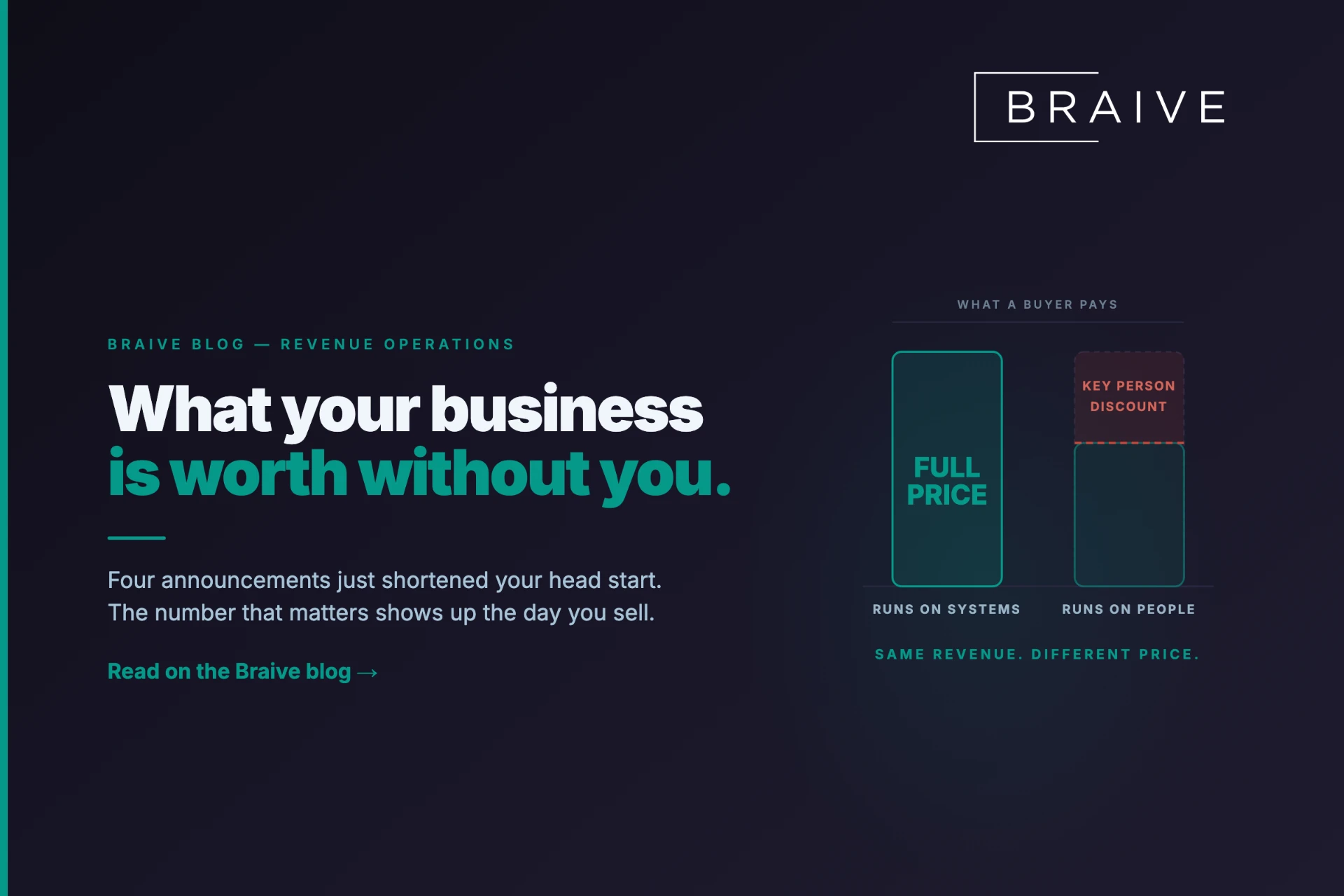
What Your Business Is Worth When You're Not in the Room
Four AI announcements just shortened your head start. What that window is worth shows up the day you sell, in an adjustment buyers call the key person discount.
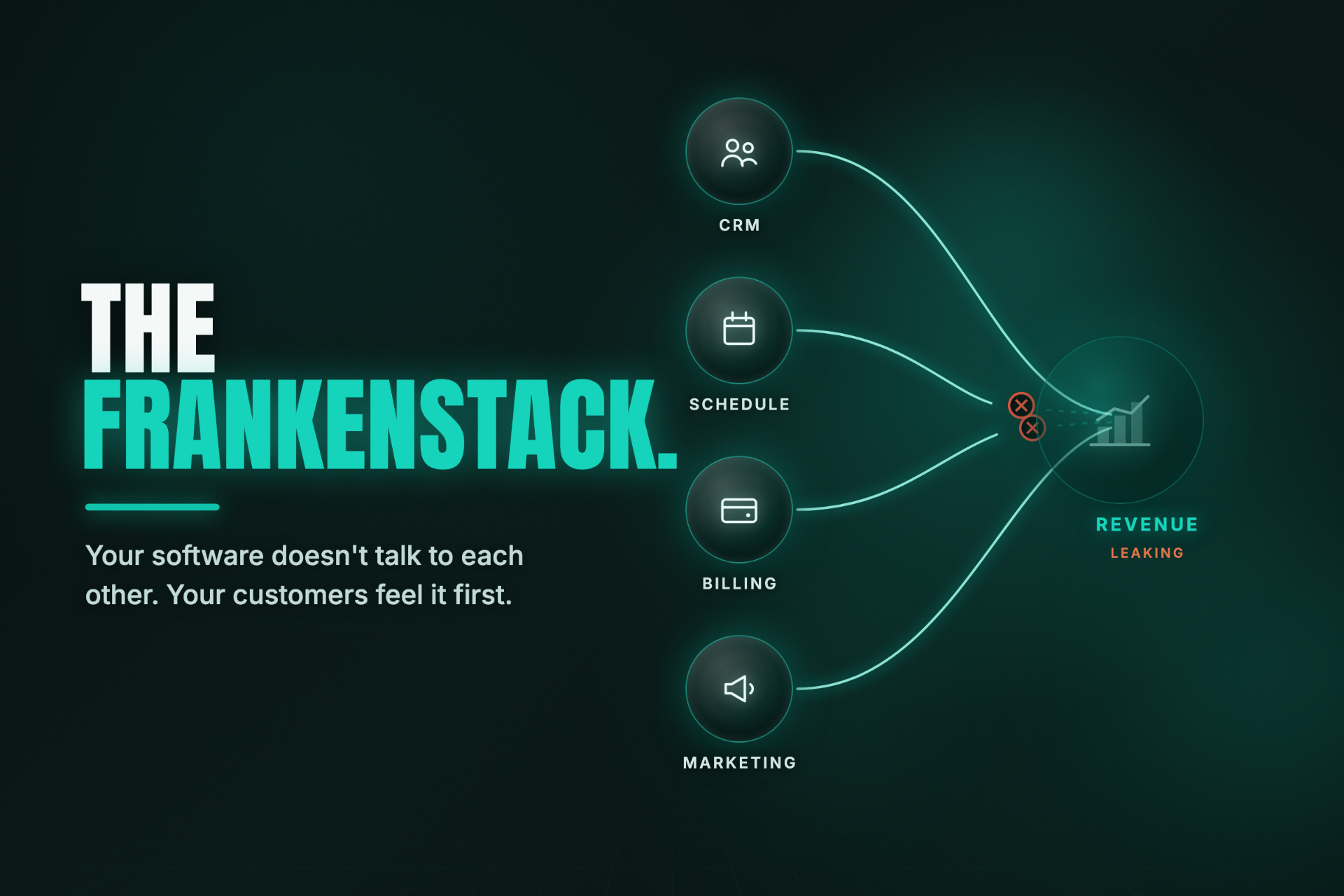
The Frankenstack: What Disconnected Software Is Costing You In Revenue
Your software doesn't talk to each other. See what the gaps between your tools cost you in lost customers and leaked revenue, and how to find them.
See where your pipeline is exposed.
12 questions. 3 minutes. Find out exactly where your operation is losing revenue — and what to do about it.