'/%3e%3cpath%20d='m3.96875-28.015625h12.03125c1.738281%200%203.28125.25%204.625.75%201.351562.492187%202.46875%201.179687%203.34375%202.0625.695312.6875%201.226562%201.5%201.59375%202.4375.375.929687.5625%201.953125.5625%203.078125v.078125c0%201.179687-.1875%202.230469-.5625%203.15625-.367188.917969-.890625%201.714844-1.578125%202.390625-.679687.679688-1.484375%201.242188-2.421875%201.6875-.929688.4375-1.9375.75-3.03125.9375l8.59375%2011.4375h-3.875l-8.125-10.890625h-8v10.890625h-3.15625zm11.75%2014.296875c1.039062%200%202-.132812%202.875-.40625.882812-.269531%201.644531-.648438%202.28125-1.140625.644531-.488281%201.144531-1.085937%201.5-1.796875.363281-.707031.546875-1.515625.546875-2.421875v-.078125c0-1.738281-.625-3.09375-1.875-4.0625-1.25-.976562-3.011719-1.46875-5.28125-1.46875h-8.640625v11.375zm0%200'%20fill='%23000'%20transform='translate(133.876559%20199.437321)'/%3e%3cpath%20d='m14.328125-28.21875h2.953125l12.765625%2028.21875h-3.390625l-3.28125-7.40625h-15.25l-3.328125%207.40625h-3.234375zm7.796875%2017.96875-6.359375-14.28125-6.40625%2014.28125zm0%200'%20fill='%23000'%20transform='translate(170.934937%20199.437321)'/%3e%3cpath%20d='m4.234375-28.015625h3.171875v28.015625h-3.171875zm0%200'%20fill='%23000'%20transform='translate(210.674618%20199.437321)'/%3e%3cpath%20d='m1.5625-28.015625h3.515625l9.96875%2024.140625%2010-24.140625h3.40625l-12.046875%2028.21875h-2.796875zm0%200'%20fill='%23000'%20transform='translate(230.444594%20199.437321)'/%3e%3cpath%20d='m3.96875-28.015625h20.234375v2.890625h-17.078125v9.5625h15.28125v2.875h-15.28125v9.8125h17.28125v2.875h-20.4375zm0%200'%20fill='%23000'%20transform='translate(268.583504%20199.437321)'/%3e%3cg%20fill='none'%20stroke='%23000'%20stroke-width='2'%3e%3cpath%20d='m.00089378.998939h147.99480122'%20transform='matrix(.75%200%200%20.75%2069.815736%20154.37189)'/%3e%3cpath%20d='m.00089378.999531h147.99480122'%20transform='matrix(.75%200%200%20.75%2069.815736%20215.461289)'/%3e%3cpath%20d='m.00230561.99905h82.37500539'%20transform='matrix(0%20-.75%20.75%200%2069.758525%20216.904073)'/%3e%3c/g%3e%3c/svg%3e)
Why 95% of Enterprise AI Pilots Fail While Small Businesses Quietly Win

The Uncomfortable Truth About AI Adoption
Here's an uncomfortable fact that most corporate leaders can't seem to admit: 95% of enterprise AI pilots fail to deliver measurable return on investment.
That number comes from a major study out of MIT, published in August 2025, and it should stop every CEO and founder in their tracks. Billions of dollars are being dumped into "innovation theater" — flashy demos and proof-of-concepts that look great in a boardroom but then collapse the moment they hit the showroom.
Meanwhile, a quiet revolution is happening. Small and mid-sized businesses (SMEs) are not only experimenting with AI, but embedding it into the core of their operations and seeing real, measurable gains in sales, marketing, and efficiency.
Research from the Wharton School, detailed in their October 2025 report, "Gen AI Fast-Tracks Into the Enterprise," highlights that these smaller, more agile companies are seeing steeper gains than their Tier 1 counterparts.
This contradiction is the most important lesson in AI today. The difference between the 95% failure rate and the quiet success stories is not about technology, budget, or talent.
It's about incentives, patience, and how an organization is built to learn.
Why Enterprise AI Pilots Keep Failing
The high rate of enterprise AI pilots failing is a structural problem. Large organizations are just not built for the way AI actually works.
The MIT study points to a core issue: corporate aversion to friction. Friction, in this context, is the resistance that forces a system to adapt and improve. The 95% of failing pilots are often those that glide "frictionless" from a demo to a deployment that is too generic, too brittle, and too disconnected from the messy reality of the business. And most businesses are pretty damn messy.
Here is how the enterprise structure works against AI adoption:
- The Pressure for Early ROI. Enterprise leaders need to justify massive spending with quick, provable returns. AI, however, is not always a light switch. It's a process that requires onboarding, training, tuning, and optimization. This pressure kills the project before any real value can emerge.
- Risk-Averse Decision-Making. Large companies are designed to avoid risk. Heavy governance, multiple approval layers, legal reviews, etc. slow the deployment process to a crawl.
- Treating AI as a Project, Not a Process. Most enterprises treat AI as a one-off IT project with a fixed budget and a fixed end date. They look for a perfect, finished product. But AI isn't a product — not even close. It's a living system.
This structural rigidity is exactly why so many AI implementation challenges are organizational, not technical. As Jin Li, Feng Zhu, and Pascal Hua wrote in a November 2025 Harvard Business Review article:
"The most significant barriers are organizational, rather than technical. Building on these findings, we identify a set of interlocking obstacles rooted in three areas: people, processes, and politics."
The Cost of Waiting Inside Large Organizations
The failure rate is also a symptom of a fundamental patience gap.
AI systems often require iteration before value appears. The first version of any AI system, whether it's a lead scoring model or a document summarizer, will be awkward, imperfect, and sometimes completely wrong.
Enterprises can't (or won't) tolerate this awkward early stage. For a mid-level manager, championing an imperfect system carries a high degree of "career risk." It's much safer to wait for a "perfect" solution than to ship a Version 1.0 that might make a public mistake. And this waiting gets expensive. Every day spent in pilot phase is a day of lost learning. The cost of waiting inside a large organization is the opportunity cost of not having a system that is actively learning and improving.
Winners in AI are those who accept that moving imperfectly is better than waiting for perfection.
Why SMEs Are Quietly Winning With AI
The small and mid-sized business world operates under a different set of incentives, which is why they are seeing genuine AI success. The Wharton research confirms that smaller firms are simply more agile. They don't have all the same layers of bureaucracy, which translates directly into faster, more effective AI deployment.
Let's compare and contrast:
| Enterprise AI Adoption | SME AI Adoption |
|---|---|
| Goal: Innovation theater, internal project | Goal: Revenue generation, operational efficiency |
| Feedback loop: Long, multi-departmental approval | Feedback loop: Short, direct from user to system |
| Tolerance: Low tolerance for imperfection (high career risk) | Tolerance: Higher tolerance for imperfection (must fix it to survive) |
| Focus: General-purpose, broad-scope pilots | Focus: Specific, high-value workflows |
For an SME, AI is a strategic tool to solve a specific, revenue-connected problem. They're not looking for a "transformative paradigm shift." They want a system that can handle lead follow-up faster, or a tool that can automate operations no one in their organization wants to do (or doesn't do well).
This direct connection to the bottom line means AI optimization is an immediate necessity. If the system isn't working, the founder or revenue leader feels the pain immediately and rushes to fix it. They're also willing to ship an imperfect system because the cost of not shipping is higher than the risk of a small mistake. They expect Version 1.0 to be wrong, and they create a system to learn from those mistakes.
AI Works Inside Workflows, Not Pilots
The most successful AI systems are invisible. They're not standalone apps. They are embedded in the existing plumbing of the business.
This is the core philosophy of operational AI. It's about taking a specific, high-volume, high-value workflow and making it faster, more consistent, and more measurable.
Here are a few examples of how SMEs use AI workflows to generate real ROI:
- Lead Response. An AI system monitors inbound leads and automatically initiates a personalized follow-up sequence within 60 seconds. This is a direct attack on the speed-to-lead problem — a proven revenue killer.
- Database Reactivation. An AI tool sifts through an old database, identifies high-potential prospects, and drafts personalized, non-salesy messages that re-engage them at the right time.
- Customer Service Triage. An AI doesn't replace the customer service team — it triages incoming requests instantly. If no one can answer the phone, a Voice AI employee picks up after the third ring and handles support or booking.
In each case, the AI is not a "pilot." It's a junior employee hired to do one job, and its performance is measured daily. This is the opposite of the enterprise approach, which often tries to build a single, all-encompassing system that does everything for everyone — and ultimately does nothing well other than annoying the people who have to work with it.
The Real Lesson About AI Adoption
The high failure rate of enterprise AI pilots and the quiet SME successes teach us one clear lesson:
The companies that win are the ones built to learn in public. They have short feedback loops, a high tolerance for iteration, and a culture that views mistakes as data points rather than career-ending events.
They think of AI not as a product launch, but as a junior employee.
When you hire a junior employee, you don't expect them to be perfect on day one. You train them, monitor their work, correct their mistakes, and expect them to get better over time. You embed them into a team and a workflow.
The enterprise treats AI like a finished product — a perfect, self-sufficient system that must deliver immediate, flawless results. When it doesn't, they fire it (cancel the pilot). The SME's AI junior employee, though, gets embedded, trained, and optimized until it becomes a high-performing part of the team.
That's why, despite the massive budgets and talent pools of the largest companies, only a small fraction of them are able to scale AI beyond the pilot stage.
Closing Perspective
AI is not failing. Incentives are.
The technology is here, and it is ready to work. The problem is that most organizations are not ready for the technology. They're still operating under a 20th-century model of project management and risk aversion that is fundamentally incompatible with the iterative, learning nature of modern AI.
The winners in this new era are the founders and operators who understand that the real competitive advantage is not the AI model they choose, but the organizational structure they build — one that lets systems mature.
Keep reading.
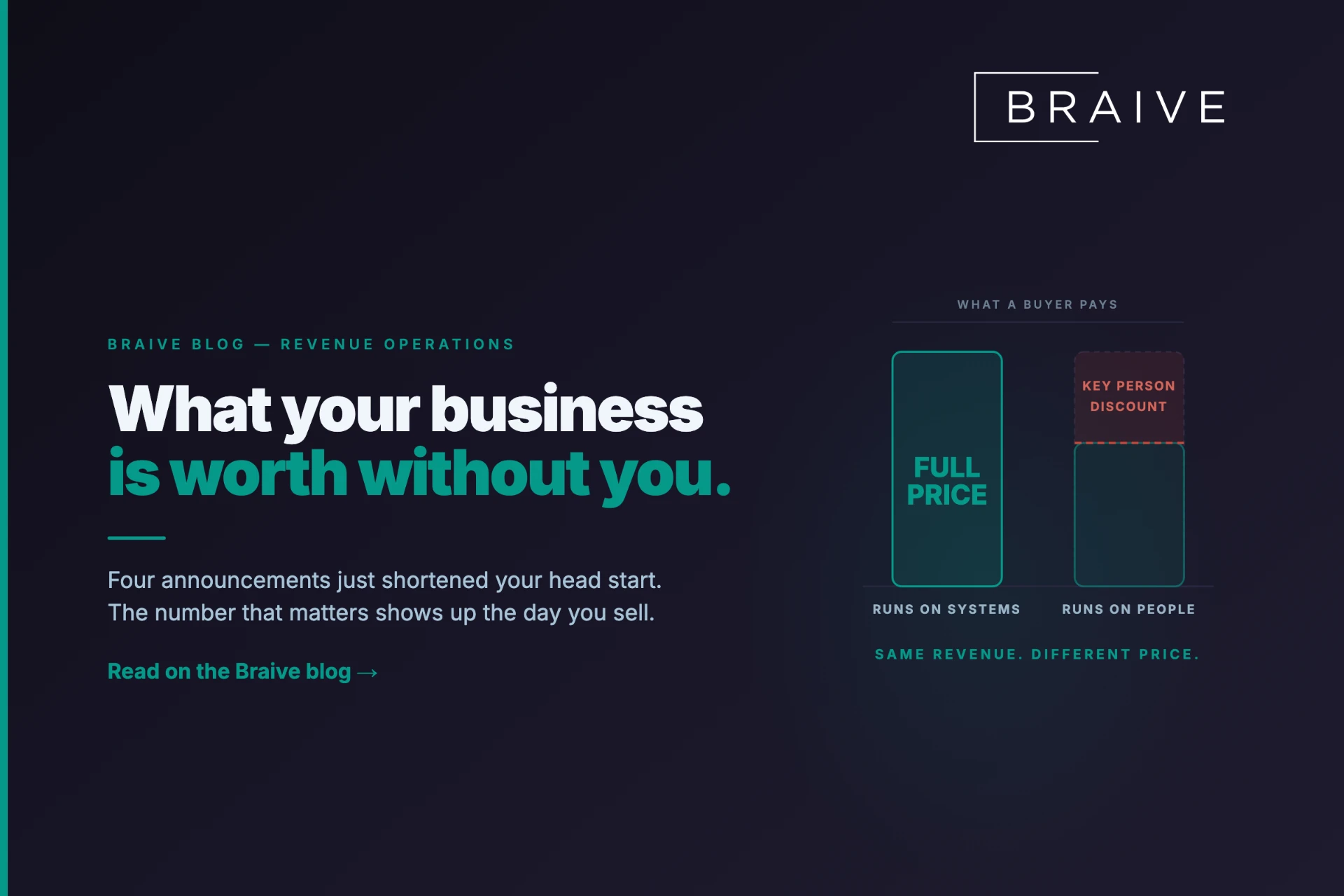
What Your Business Is Worth When You're Not in the Room
Four AI announcements just shortened your head start. What that window is worth shows up the day you sell, in an adjustment buyers call the key person discount.
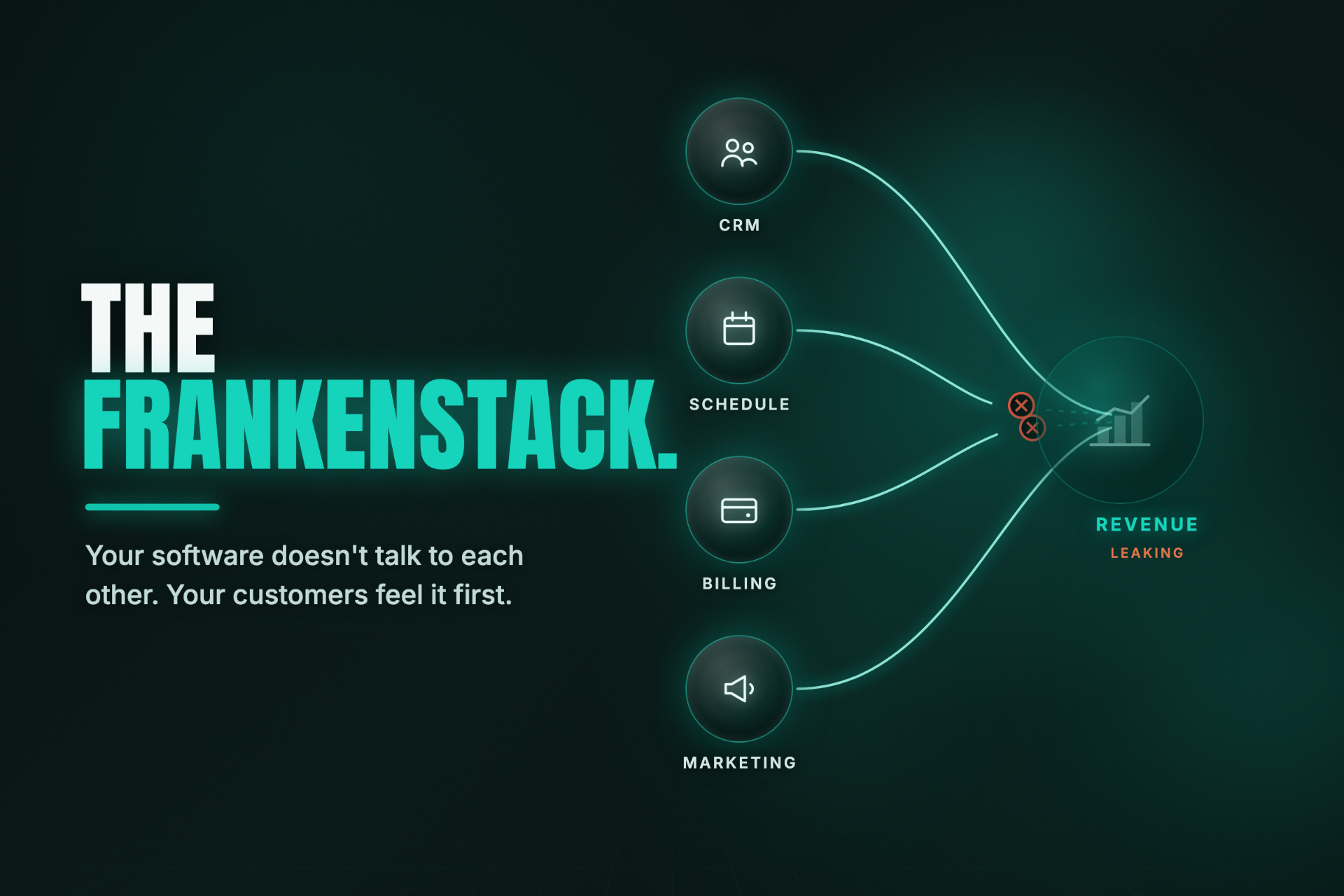
The Frankenstack: What Disconnected Software Is Costing You In Revenue
Your software doesn't talk to each other. See what the gaps between your tools cost you in lost customers and leaked revenue, and how to find them.
See where your pipeline is exposed.
12 questions. 3 minutes. Find out exactly where your operation is losing revenue — and what to do about it.